
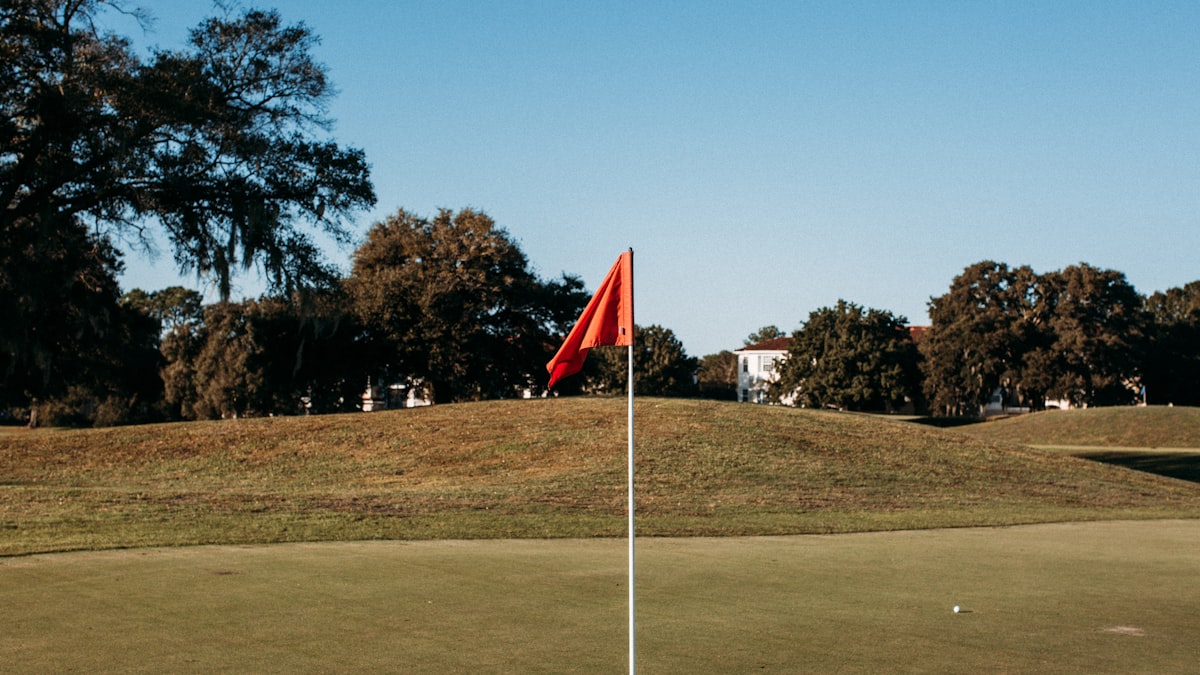
Golden Bell: 155 Yards That Decide the Masters
The 90th Masters starts next Thursday. Scottie Scheffler is the defending champion. Rory McIlroy wants the career Grand Slam. Xander Schauffele, Ludvig Aberg, and a deep field of contenders will walk Augusta National's fairways chasing a green jacket.
None of that matters until Sunday afternoon at the 12th hole.
Golden Bell is 155 yards long. It's a wedge for most of the field. And it has wrecked more Masters Sundays than any other hole in golf.
The design is simple. That's the problem.
Alister MacKenzie and Bobby Jones built the 12th as a straightforward par 3. Tee box on one side of Rae's Creek, green on the other. No dogleg, no blind landing area, no optical illusion. You can see exactly where you need to hit it.
The green sits at the bottom of a natural amphitheater carved between tall Georgia pines. It's shallow, just 16 yards from front to back, roughly half the depth of an average Augusta green. Rae's Creek runs directly in front. Two bunkers sit behind the green, one more guards the front right.
On a calm day, it's an 8- or 9-iron for a Tour pro. Comfortable. Routine, even.
The problem is that calm days at Golden Bell are rare. The trees surrounding Amen Corner create a wind tunnel that swirls in unpredictable patterns. You can toss grass in the air on the tee and watch it blow left, then look at the flag on the green and see it pointing the opposite direction. Players have reported hitting the same club within minutes of each other and having one ball land 20 yards short and the other fly 15 yards long.
Club selection at the 12th ranges from a 6-iron to a 9-iron depending on the wind. That's a four-club spread on a hole where the margin between a birdie putt and Rae's Creek is about 10 feet.
The graveyard shift
Golden Bell has a body count. Here are the ones that still sting.
Tom Weiskopf, 1980. First round. Weiskopf put five consecutive balls into Rae's Creek and made a 13, the highest score ever recorded on the hole. Thirteen on a par 3. He needed eight fewer shots just to make double bogey.
Jordan Spieth, 2016. This one still hurts to watch. Spieth stood on the 12th tee on Sunday with a five-shot lead. He'd already made back-to-back bogeys on 10 and 11, but five shots is five shots. Then his tee shot found the water. His drop shot found the water again. When it was over, he'd made a quadruple-bogey 7, and Danny Willett walked away with the green jacket.
Spieth said afterward that the 12th "just has people's number." He wasn't wrong. The hole had already started picking him apart on 10 and 11, and then it finished the job.
The entire 2020 field. In the final round, the 12th ate the field alive. Five players found the water that Sunday, including Tiger Woods, who made a 10. The hole played well over par on a day when every player in the field was hitting a short iron.
Tiger's 10 on the hole in 2020 deserves its own paragraph. He was the defending champion. He put three balls in Rae's Creek. Three. The greatest closer in major championship history, standing over a 9-iron, dumping shot after shot into a creek he'd crossed hundreds of times. That's what Golden Bell does. It doesn't care about your resume.
Fred Couples and the ball that refused to die
The flip side of all that carnage is 1992. Fred Couples hit a tee shot on the 12th that caught the front bank, the same slope that feeds balls down into Rae's Creek. Everyone watching assumed it was gone. The ball landed, rolled toward the water, and stopped. Just sat there on the bank, a foot or two from the creek, as if it had decided this wasn't the day for tragedy.
Couples chipped up and made par. He won the Masters by two shots over Raymond Floyd, who had double-bogeyed the same hole.
Golf has a word for this: luck. But Couples' ball stopping on that bank wasn't entirely random. He'd hit it a fraction short of the green rather than trying to carry it to the pin. The safe miss at 12 is always short. Long puts you in the back bunkers with a downhill explosion shot toward the water. Left or right leaves awkward chips on severe slopes. But short, if you're lucky, stays on the bank. And sometimes the bank saves your tournament.
What the 12th teaches about short par 3s
Most golfers treat short par 3s as birdie holes. Free strokes. On a 155-yard hole, you should be able to stick it close and make your putt, right?
Golden Bell argues otherwise. Short par 3s are the most misunderstood holes in golf, at Augusta and at your home course. Here's what the 12th gets right about design, and what you can steal for your own game.
The danger isn't distance. It's precision. A 155-yard shot eliminates the difficulty of hitting the ball far enough. What it doesn't eliminate is the difficulty of hitting the ball to the right spot. When the green is shallow and the penalty for missing is severe, the shot becomes about judgment and touch, not power. Your home course probably has a short par 3 with water or a steep drop-off. Treat it with the same respect you'd give a 220-yarder.
Wind changes everything on short holes. On a 450-yard par 4, a 10 mph crosswind moves your ball a few yards. Manageable. On a 155-yard par 3, that same wind can push a shot two clubs' worth of distance offline. Pros at the 12th wait on the tee, watching the tops of the trees, trying to time their swing to a gap in the gusts. You should do the same thing on any short par 3 where wind is a factor. Don't rush the shot. Wait for your window.
Know your miss. Couples survived the 12th because his miss was in the right place. Every short par 3 has a safe miss and a dead miss. Before you pull a club, figure out where you can afford to be wrong. At Golden Bell, it's short. At your course, it might be left or right or long. The point is to think about it before you swing, not after your ball is wet.
The best theater in golf
The Masters broadcast always lingers on the 12th during Sunday's back nine. There's a reason for that. It's the best theater in golf because the outcome is genuinely unpredictable. A player can be five shots clear and lose everything in 90 seconds. Another player can get a lucky bounce off a bank and win a major.
Next week, someone will stand on that tee box on Sunday with the tournament hanging on a 9-iron. The wind will be doing something different at the green than it's doing at the tee. Rae's Creek will be waiting. The green will be 16 yards deep and faster than anything you've ever putted on.
And the rest of us will watch, knowing that 155 yards is all it takes to change everything.